
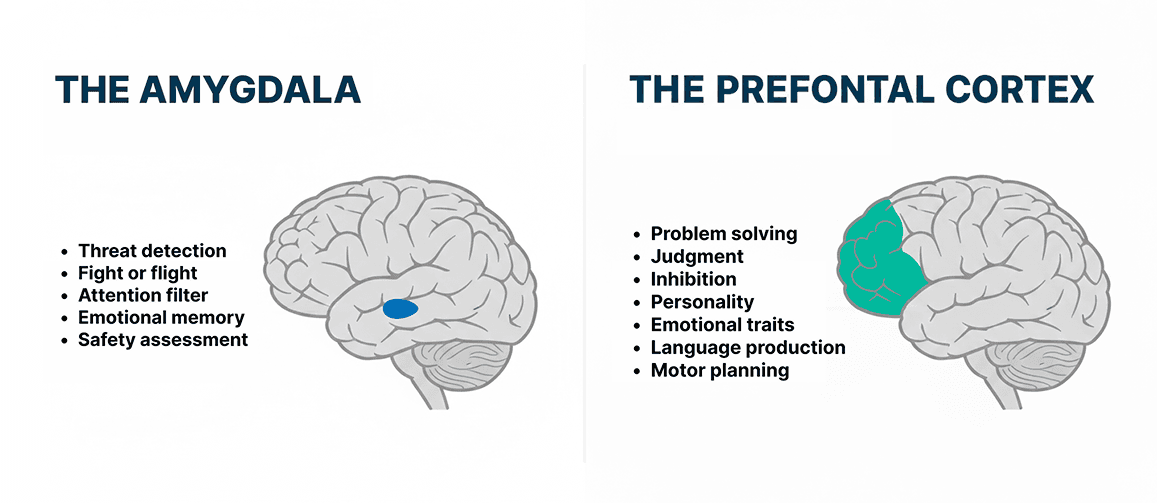
Naming your emotions, a practice often called affect labeling, matters because it can transform a vague, overwhelming physical sensation into a concrete piece of information. When that shift happens, the brain’s stress response often eases, and it becomes easier to choose how to react rather than going straight into escalation or shutdown.
Why it works
When you’re swept up in a “feeling,” the amygdala (the brain’s alarm system) tends to be more active. By simply finding a more accurate word, moving from “bad” to “invalidated,” “overwhelmed,” or “uncertain,” you engage the prefrontal cortex, the part of the brain that supports reflection, judgment, and self-control.
You don’t need the perfect label. You need a good-enough label that helps your brain organize what’s happening.
What this gives you
- De-escalation: Research suggests that labeling an emotion can lower its physiological intensity in the moment.
- Clarity: It acts like a speed bump, creating a small pause so you can decide on a healthier response.
- Connection: Precise language helps other people understand your needs, which can reduce conflict and loneliness.
Symptoms
- Difficulty identifying feelings (DIF)
- Difficulty describing feelings (DDF)
- Externally oriented thinking (EOT)
- Low emotion vocabulary (for example, “fine”, “off”, “stressed”)
- Going blank when asked about feelings
- Emotional flatness, numbness, or shutdown
- Feeling overwhelmed but unable to name it
- Irritability without clear emotional meaning
- Physical distress without a clear cause
- Body cues not linked to emotions
- Quick problem-solving when emotion rises
- Events and logistics emphasized over inner meaning
- Difficulty expressing needs and boundaries
- Conflict escalation or shutdown
- Relationship strain
- Delayed clarity (realizing later what you felt)
Why does this matter?
When you cannot name what you feel, it is harder to do anything with it. Your body can be loud, but without usable words, it is easy to get stuck in “bad,” “fine,” or “I do not know.”
Research has shown that affect labeling, simply putting feelings into words, can reduce emotional reactivity in the moment and increase choice about what happens next. You do not need the perfect label. You need a good-enough label that makes the experience more workable.
How Feelpath can help you name your emotions
Feelpath is designed to support therapy when naming a feeling is difficult in the moment, without turning it into a test. You stay in control of what you use and what you keep.
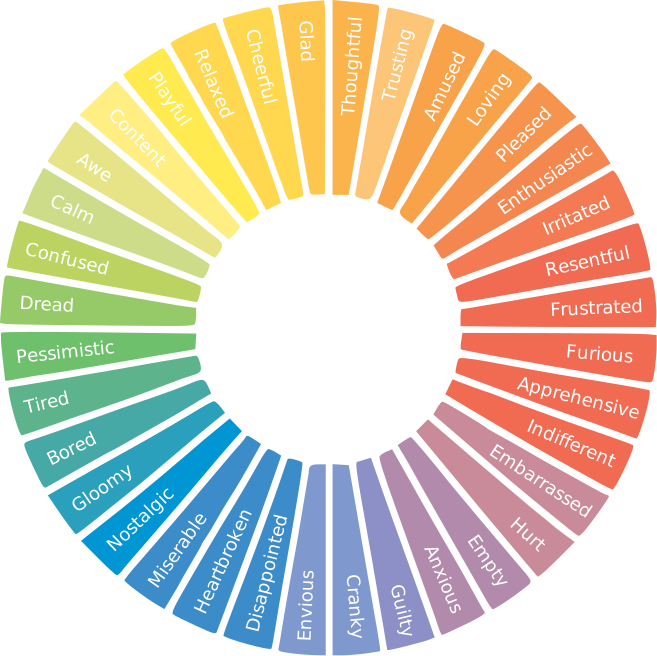
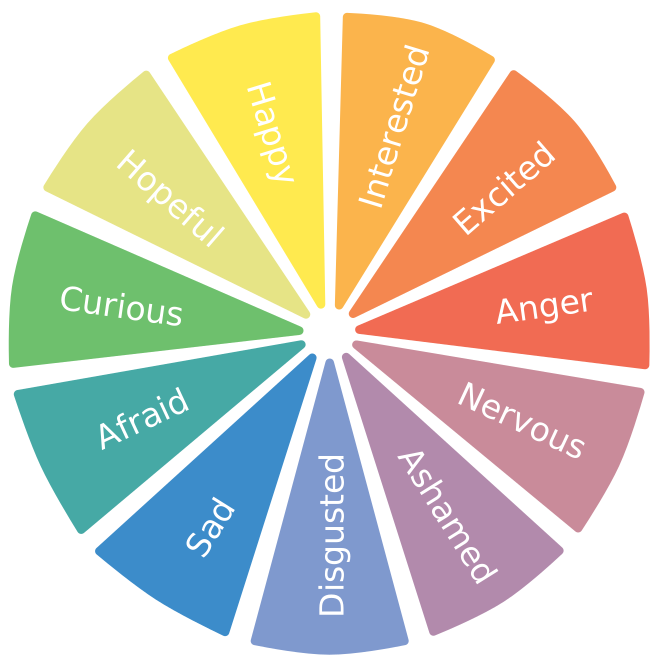
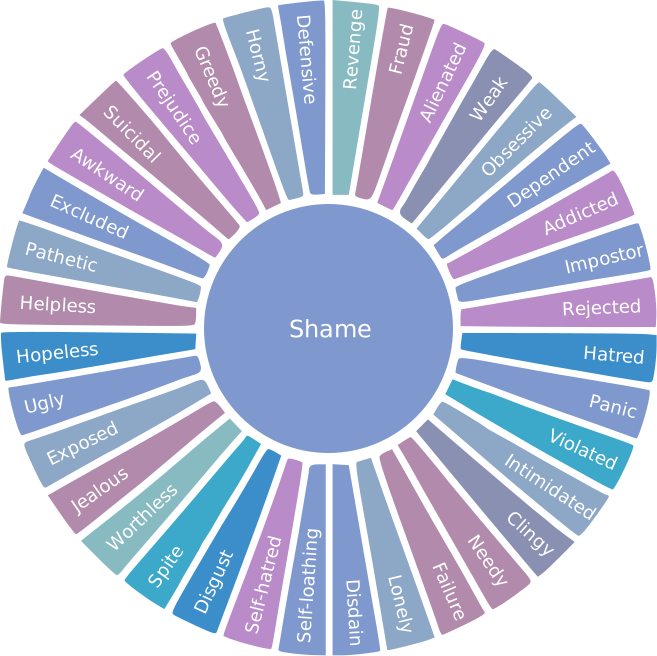
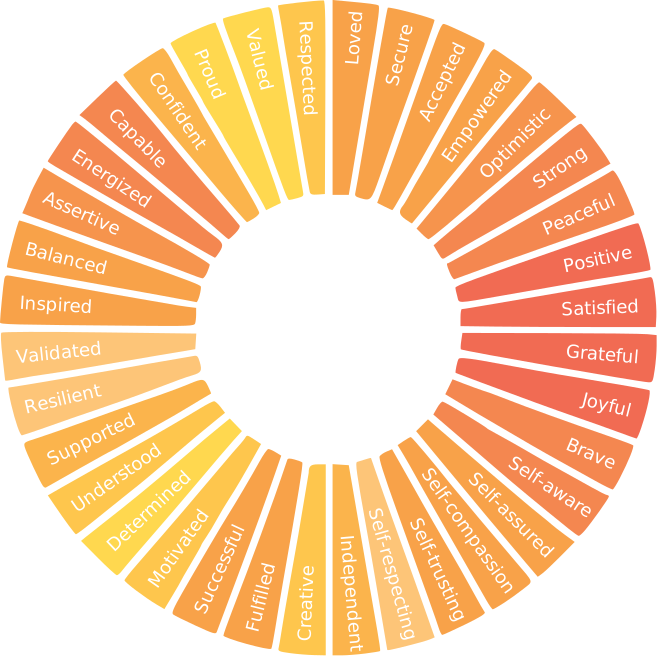
- Find words in session: Use an emotion wheel as a menu when “I don’t know what I feel” is the only answer.
- Practice naming feelings in context: Label emotions from your own session excerpts, at your pace.
- Notice patterns over time: When change is subtle, it can help to see what repeats, without scoring you.
What you’ll see in Feelpath
Guided walkthrough
What you’ll see in Feelpath
A gentle way to build emotion words from real sessions, at your pace.

Guided walkthrough
What you’ll see in Feelpath
A gentle way to build emotion words from real sessions, at your pace.
Bring this into therapy
If you want a simple way to start, you can say something like:
“I’m not sure what I feel yet, but I can tell something is there. Can we slow down and try to name it together, even if the first word is only close?”
If you are working with a clinician and you want a quick explainer of what Feelpath is and what you can use or leave off, see How to explain Feelpath and Insights to your clients.
If you want to explore Feelpath, you can book a short walkthrough.