
10 tools to better support your client's emotional development
Feelpath is a teletherapy platform with transcript-grounded tools for psychoeducation and reflection.
- Make emotions easier to name and revisit
- Support reflection between sessions without homework
- Keep trust central: consent-first by design


Join your session

00:12 · Client: I just felt off but could not say what.
03:47 · Client: Weekend was fine. I do not really know what I felt.
A Feelpath story
Meet Ellie & Theo
See why a therapist and client tried Feelpath—and how clearer emotion language can carry from one session into the next.

Note from the founder
Hello! My name is Nick. For years I lived with alexithymia without knowing the word for it.
Being largely unaware of my internal emotional experiences strained my interpersonal relationships, increased my depression and anxiety, and created hurdles to engaging in therapy.
When I learned that alexithymia is a modifiable trait, and with the encouragement of my therapist, I started building Feelpath. I designed Feelpath so that therapy clients like myself can heal more effectively and therapists can deliver better care for alexithymia.
Feelpath offers alexithymia detection for therapists and education for clients, so others like me can get the guidance and attention needed to strengthen their emotional awareness and communication skills.

Nick Venturino
Founder, Feelpath
Feelpath is for therapists who want to be emotionally attuned and objectively grounded at the same time.
Stay present during the session, then review insights anchored to the session conversation.
Stay present
Make feelings easier to name and discuss collaboratively.
Feelpath stays quiet during session—no prompts or coaching. Use tools only when you and the client choose.
No scribbling, no questionnaires, no divided attention.
Clinician POV
“Feelpath makes emotion work observable and discussable, grounded in the transcript, so I choose interventions with more confidence.”
Key idea
Measurements can be derived from clients' spontaneous language during psychotherapy. Then inspected, compared over time, and tied back to excerpts.
Shifts over time
Longitudinal views help you see what’s changing across sessions, so small shifts don’t get lost.
Everything is tied back to the transcript, so you can check the evidence.
Excerpt-linked
Client: I felt off all week, but I couldn’t name it.
Therapist: Where do you notice that in your body?
Trends over time
Example visualization for layout only.
What is Alexithymiaand why we're building the Alexithymia Language Index (ALI)
Alexithymia (difficulty identifying and describing emotions) is common: around 10% of the general population meet criteria for alexithymia, and estimates range from 50–85% among many autistic and ADHD populations.[1,2]
It is strongly linked to interpersonal distress, insecure attachment patterns, and developmental factors such as early language delays and a reduced sense of agency.[3]
The measurement gap
- Self-report scales can miss in-session behavior and short-term change.
- Few workflow-friendly measures capture alexithymia-related language in-session.
The Alexithymia Language Index (ALI) tests whether session-derived language measures can help close this gap.[4,5]
Core features of alexithymia
Hard to know what I'm feeling.
Feelings are present but vague or blurry.
Hard to put feelings into words.
Emotions are felt but not easily described.
Focus on facts more than inner life.
Attention goes to events, not inner reactions.
Body sensations and emotions blur together.
It is hard to tell physical cues from emotional states.
Selected references
- Population study of alexithymia prevalence and sociodemographic correlates in Finnish adults. PubMed.
- Adolescent community study reporting alexithymia prevalence and links to emotional and behavioral difficulties. PubMed.
- Recent work on alexithymia, attachment, and developmental factors such as early language delays and agency. BMC Psychiatry.
- General‑population study linking alexithymia with somatization and physical symptom burden. PubMed.
- Emerging digital and behavioral approaches to identifying alexithymia using language and interaction patterns. JMIR Mental Health.
Help emotion skills stick between sessions
Many clients need more than talk to integrate change. Feelpath adds visual, interactive tools that support practice and make sessions easier to revisit, especially for neurodivergent clients. You stay in control of what is shared, and when.
Our approach:
- Visualize patterns and progress over time.
- Offer interactive tools your clients can try when they are ready.

Neurodivergences & Emotion Difficulties
Emotions show up differently across people and neurotypes. This table highlights a few commonly reported patterns of difficulty / strain across domains. When emotional awareness is harder (alexithymia), regulation, executive functioning, and social-emotional inference can get harder too—especially under stress.
| Profile | AlexithymiaLow emotional awareness | Emotion dysregulationDysregulation under stress | Social-emotional skill gaps†Difficulty with empathy & perspective-taking | Executive dysfunctionDifficulty with planning, initiation & follow-through |
|---|---|---|---|---|
| ADHD | ◐ | ● | ◐ | ● |
| Autism (ASD) | ● | ● | ◐ | ◐ |
| AuDHD | ● | ● | ◐ | ● |
| CEN* | ● | ● | ◐ | ◐ |
| HSP* | ◐ | ◐ | ◐ | ◐ |
| Trauma / CPTSD | ● | ● | ◐ | ◐ |
| Anxiety / Depression & Perfectionism | ◐ | ● | ◐ | ◐ |
Table notes: Cells with a corner marker in the table above contain cell-specific details. Hover to preview, or click/tap anywhere in the cell.
Research references
Selected peer-reviewed sources supporting the main patterns summarized in this table, including the idea that alexithymia (low emotional awareness) can cascade into harder regulation, social-emotional inference, and downstream functioning—especially under stress.
- Kinnaird, Stewart, & Tchanturia (2019): Investigating alexithymia in autism: A systematic review and meta-analysis
- Bird & Cook (2013): Mixed emotions: the contribution of alexithymia to the emotional symptoms of autism
- Craig et al. (2016): Executive functioning in children/adolescents with high-functioning autism: a meta-analysis
- Demetriou et al. (2020): Executive function in autistic adults: a meta-analysis
- Bora et al. (2013): Meta-analysis of neuropsychological tests in major depressive disorder (incl. executive function)
- Scott et al. (2015): A quantitative meta-analysis of neurocognitive functioning in posttraumatic stress disorder
- Trevisan et al. (2019): Interoceptive awareness and alexithymia: A meta-analysis distinguishing accuracy vs sensibility
- Laloyaux et al. (2015): Evidence of contrasting patterns for suppression vs reappraisal emotion regulation strategies in alexithymia
- Kiraz, Sertçelik, & Taycan (2021): Alexithymia and impulsiveness in adults with ADHD (primary study)
- Edel et al. (2010): Alexithymia, emotion processing, and social anxiety in adults with ADHD (primary study)
- Herpertz et al. (2024): Emotion processing difficulties in ADHD: a Bayesian meta-analysis
- Ditzer et al. (2023): Childhood maltreatment and adult alexithymia: a meta-analysis
- McDonald et al. (2024): Emotion dysregulation in autism: A meta-analysis
- Song et al. (2019): Empathy impairment in autism spectrum conditions from a multidimensional perspective: A meta-analysis
- Milton (2012): On the ontological status of autism: The “double empathy problem”
- Crompton et al. (2020): Neurotype-matching (not autistic status) influences ratings of interpersonal rapport
- Di Tella et al. (2024): On the relationship between alexithymia and social cognition: A systematic review
- Beheshti et al. (2020): Emotion dysregulation in adults with ADHD: a meta-analysis
- Edwards (2022): Posttraumatic stress and alexithymia: A meta-analysis of presentation and severity
- Khan & Jaffee (2022): Alexithymia in individuals maltreated as children and adolescents: a meta-analysis
- Somerville et al. (2024): Emotion controllability beliefs and young people’s anxiety and depression: A systematic review
- Acevedo et al. (2018): Sensory processing sensitivity brain circuits review
- Network-based meta-analysis of sensory processing sensitivity (2025): Relations with personality/temperament traits
† In this table, “difficulty reading emotion / empathy” refers to how easy it is to read cues and infer what someone might be feeling/meaning (emotion recognition and perspective-taking), not how much someone cares. This domain is also harder to measure and comparatively under-researched, so the notes are meant to add nuance and reduce overgeneralization.
* CEN (Childhood Emotional Neglect) is an experience; HSP (Highly Sensitive Person) is a temperament trait. They’re included because support needs often overlap with neurodivergent profiles.
10 tools to better support your client’s emotional development
Opt-in tools, approved by you, when your client is ready.
Session Review
A clear recap of key moments so clients can revisit what mattered between sessions.
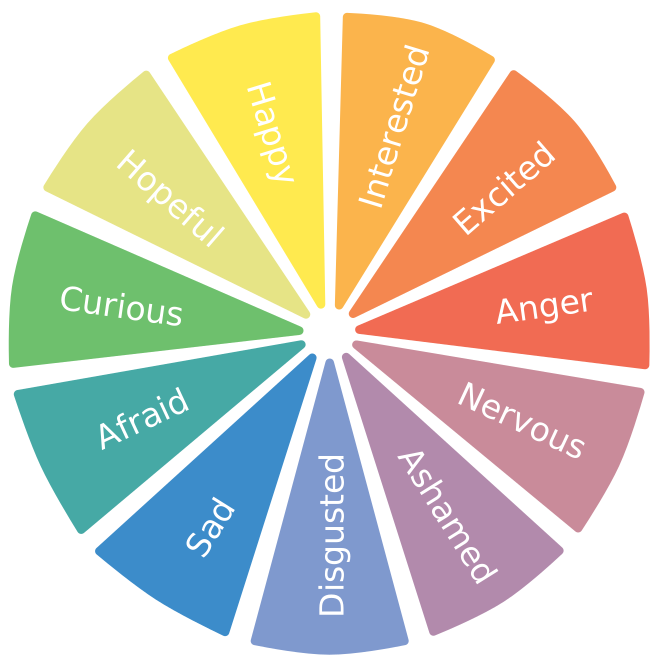
Smart Emotion Wheels
Visual support for finding precise words for feelings, without pressure or jargon.
Emotion Annotation
Lightweight highlights that connect language to feelings and themes over time, including emotions clients add during reflection.
Emotional Vocabulary Analytics
A gentle view of emotion-word patterns that can make growth easier to notice.
Self-Guided Psycho-education
Coming soonClient-ready explanations and exercises you can opt into when the timing is right.
Guided meditations
Short, grounded practices that help clients slow down and tune into internal cues.
Real-time Emotion Suggestions
Prompts that offer emotion-language candidates during reflection and review.
Personalized Emotional Coping Strategies
Coming soonSkills and strategies matched to what clients are working on, at their pace.
Self-Talk Analysis
A way to notice inner narratives and patterns that shape mood, behavior, and self-regard.
Executive Functioning Skills
Coming soonTools that support follow-through and structure when attention and planning are hard.
How Feelpath works
Feelpath is a video platform for telehealth therapy sessions, suitable for clinical and research use.
Join your session
00:12 · Client: I just felt off but could not say what.
03:47 · Client: Weekend was fine. I do not really know what I felt.
Session Transcript
Stay close to what was actually said
Session language is captured as a transcript that can be searched, highlighted, and revisited together.
Transcript highlights
Client: I just felt off but could not say why.
Therapist: When you say off, what do you notice in your body?
Client: Weekend was fine. I do not really know what I felt.
Highlighted language
Integrations & exports
Create clean session takeaways and progress snapshots you can save, print, or share (with consent).
Designed to copy/paste neatly into your existing EHR (e.g., SimplePractice), with no rip‑and‑replace.
Built for remote sessions with a calm in‑session experience and low‑friction client join.
What Feelpath allows you to do
For clinicians
- Be more informed and more present
- Revisit sessions quickly
- Notice patterns over time
- Reduce prep and post-session work
- Improve alignment & alliance
For clients
- Stronger engagement
- Shareable wins
- Clarity on goals
Your information, your choices
Individuals can control access to their transcripts post-session with revocable consent. If a transcript was previously shared with a therapist, the ability to revoke consent is always available to the individual.
Download your session transcripts in text format anytime. Keep your own records of your therapy journey for personal reflection and tracking over time.
To delete your account, contact support@feelpath.com.
HIPAA in Practice
We take a comprehensive HIPAA-compliant approach to protecting your most sensitive information. Here's what it means for you:
Encryption at Rest
Your data is encrypted when stored on our servers using AES-256 encryption—the same standard used by banks and government agencies. Even if someone gained physical access to our servers, your data would be unreadable.
Encryption in Transit
Every bit of data traveling between your device and our servers is protected with TLS 1.3 encryption. It's like sending your information in an armored vehicle that only you and your therapist can unlock.
Auditable Compliance Logs
Every access to your data is logged and auditable. We monitor who accessed what, when, and why—creating a transparent trail that ensures accountability.
Running a HIPAA-Compliant Business
Our entire company operates under HIPAA guidelines. From employee training to physical security, every aspect of our business is designed to protect your privacy.
Your privacy isn't just important to us—it's fundamental to everything we do. We built Feelpath because we believe our technology can enhance therapy while respecting its sacred, confidential nature.
We promise to always be transparent about our practices, give you control over your data, and continuously work to earn and maintain your trust.
If you ever have questions about your privacy or want to understand more about how we protect your data, please reach out to us at support@feelpath.com. We're here to help you feel completely reassured about your security.
FAQ
Short answers to the questions therapists ask most, organized by clinical use, fit, and safety.
Overview
FeelPath is a telehealth video platform with consent-based transcripts and insights that help you build emotion language and work with alexithymia more effectively.
Clinicians who want a calmer way to help clients notice, name, and track emotions over time. It can be especially helpful when clients struggle to find the right words in session.
Sessions work like normal telehealth. Feelpath is designed to be non-intrusive during sessions, with transcript capture and light-touch tools used only when you and the client choose.
With consent, FeelPath uses the session transcript to surface themes, highlights, and follow-ups grounded in transcript excerpts. You can ignore, edit, or discard anything.
Clients see their session experience and any features they have consented to. Insights are clinician- and patient-facing by default and can be shared selectively when it supports care.
No. It supports recall and pattern-spotting, but you remain the decision-maker.
It is designed to be lightweight. Many clinicians do a quick review before or after session to refresh context, notice emotion-language patterns, and plan follow-ups. If you want to spend more time, you can go deeper and learn more about your client, but nothing is required between sessions.
Consent, Privacy & Safety
You control capture on a per-client, per-session basis. Clients can understand what’s saved, what you can use or leave off, and what’s shared. You choose what to use clinically.
You and your client control your data. We don’t sell it. We don’t train AI models on your content.
We support HIPAA-aligned workflows and can provide a BAA for covered entities. For your specific setting, confirm details with our team.
Read our privacy overviewYou can correct transcripts and edit/redact content. The goal is clinician control. Nothing is “final” without your review.
No. Feelpath is not a diagnostic tool and it does not triage or replace clinical risk assessment. Use your judgment and established crisis protocols.
No. Feelpath isn’t an emergency service. In a crisis, clients should contact local emergency services or a crisis line (e.g., 988 in the U.S.) and reach out to their clinician or care team.
Neurodivergence & Therapy Modalities
It’s helpful wherever emotion awareness and language would support goals (e.g., anxiety, depression, relational strain, health stress, many trauma-informed contexts with pacing). It is not a crisis tool and doesn’t replace higher levels of care.
No. The goal is not “perform the right emotion.” Feelpath is designed to support autonomy and healthy self-expression: clearer self-understanding, safer expression, and language for needs. It does not push clients toward social conformity.
No. It’s designed to be modality-flexible (e.g., CBT, ACT, psychodynamic, EMDR, IFS). You decide what’s relevant and what to ignore.
Today, Feelpath is designed for telehealth sessions on the platform. In-person capture isn’t the primary workflow right now.
Yes. Feelpath can support multi-client or group sessions. Consent and sharing controls remain central for each participant.
Yes, for many clients 13 and older. Minor consent rules vary by state and situation, so the treating clinician should confirm what applies for the client’s location and document the required consent before using FeelPath. FeelPath currently supports therapist and patient access only and does not provide parent or guardian access.
Integrations, Exports & Pricing
Feelpath is designed to work alongside your EHR via clinician-friendly structure and exports. You don’t need to switch systems to start.
Yes. Exports are designed to be easy to save and share with consent (for example, transcript downloads and clinician-friendly outputs).
Pricing depends on your plan and feature set. You can review current options on our pricing page.
View pricingBook a 15-minute walkthrough. If Feelpath fits your practice, Nick will personally set up your account.
Book a 15-minute walkthroughTechnical
Feelpath works on major modern browsers across desktop and tablet. For the best experience, use an up-to-date browser.
Right now, Feelpath is available in English.
Curious to learn more? Book a 15‑minute walkthrough.
Get two months free after your walkthrough. Then $39/month, with clients included.