
What is Alexithymia?
When feelings are hard to notice and name.
Alexithymia refers to difficulty noticing feelings, telling them apart, putting them into words, and working with them.
Higher severity usually means more trouble identifying, describing, and processing emotions, often showing up as confusion, irritability, numbness, or shutdown.
What it means
Alexithymia is best understood as a difficulty with emotional awareness and using emotion language. The common measures of alexithymia (PAQ, TSQ, etc.) are designed around these self-report items.
Difficulty identifying feelings
Noticing internal emotional cues and differentiating feelings from bodily sensations.
Difficulty describing feelings
Finding accurate words and sharing emotions effectively with other people.
Externally-oriented thinking
Attention goes to outside events and practical details more than inner meaning.
Alexithymia Scales:
TAS vs PAQ vs ALI
A quick, high-level comparison of the widely used self-report scales VS. our conversation-derived ALI approach.
TAS-20
Toronto Alexithymia Scale
- 20-item self-report checklist.
- Global alexithymia score plus three subscales.
- Widely used benchmark in research.
PAQ-24
Perth Alexithymia Questionnaire
- Self-report with positive and negative emotion subscale scores.
- Richer profile of identifying and describing feelings.
- Still relies on people rating themselves on items.
ALI
Alexithymia Language Index (Feelpath)
- Conversation-derived indices from session language.
- Component-aligned scores tied to concrete, labeled excerpts.
- Designed to complement TAS/PAQ, not replace them.
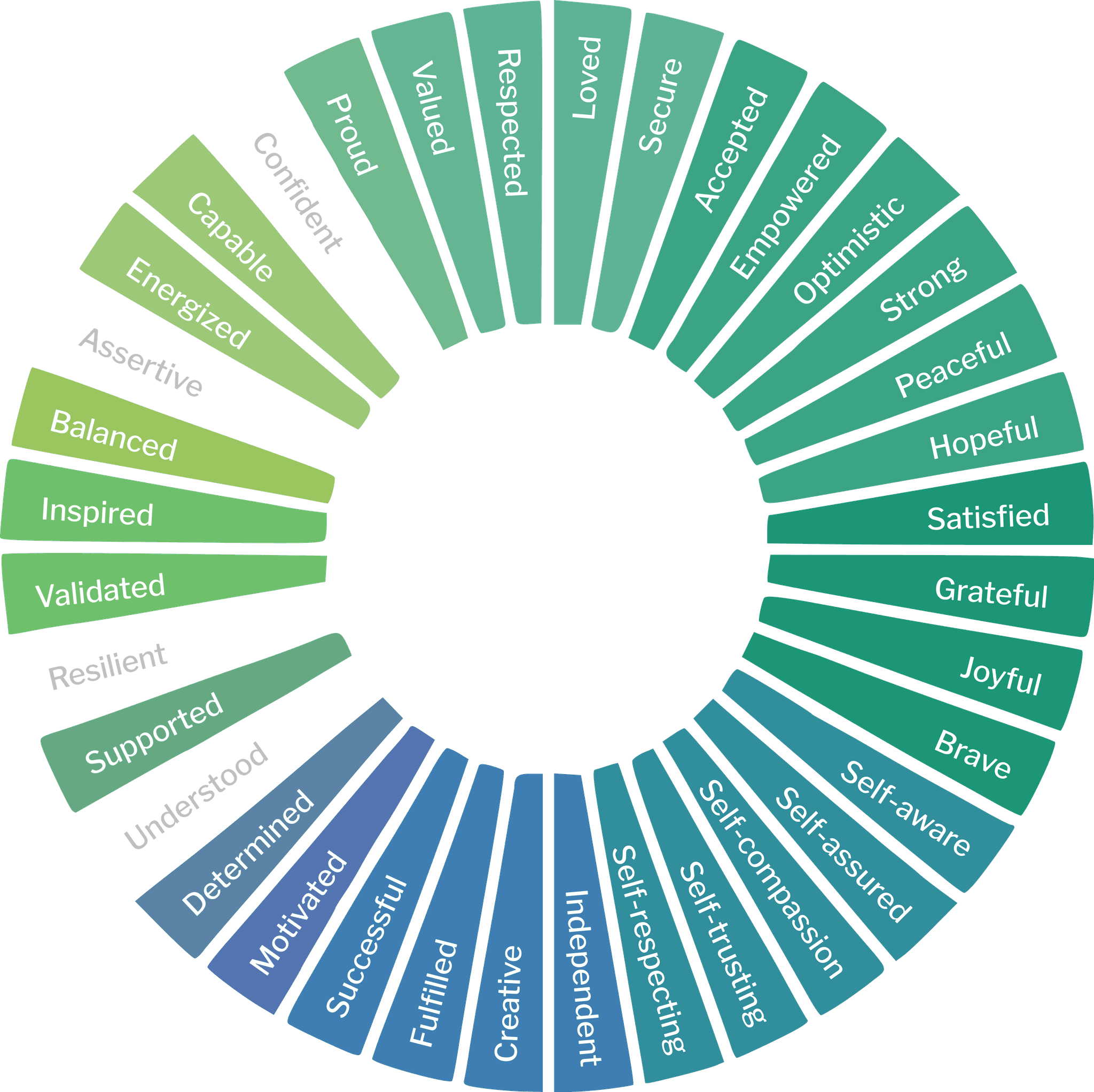
Feelpath Smart Emotion Wheel Example
Neurodivergences & Emotion Difficulties
Emotions show up differently across people and neurotypes. This table highlights a few commonly reported patterns of difficulty / strain across domains. When emotional awareness is harder (alexithymia), regulation, executive functioning, and social-emotional inference can get harder too—especially under stress.
| Profile | AlexithymiaLow emotional awareness | Emotion dysregulationDysregulation under stress | Social-emotional skill gaps†Difficulty with empathy & perspective-taking | Executive dysfunctionDifficulty with planning, initiation & follow-through |
|---|---|---|---|---|
| ADHD | ◐ | ● | ◐ | ● |
| Autism (ASD) | ● | ● | ◐ | ◐ |
| AuDHD | ● | ● | ◐ | ● |
| CEN* | ● | ● | ◐ | ◐ |
| HSP* | ◐ | ◐ | ◐ | ◐ |
| Trauma / CPTSD | ● | ● | ◐ | ◐ |
| Anxiety / Depression & Perfectionism | ◐ | ● | ◐ | ◐ |
Table notes: Cells with a corner marker in the table above contain cell-specific details. Hover to preview, or click/tap anywhere in the cell.
Research references
Selected peer-reviewed sources supporting the main patterns summarized in this table, including the idea that alexithymia (low emotional awareness) can cascade into harder regulation, social-emotional inference, and downstream functioning—especially under stress.
- Kinnaird, Stewart, & Tchanturia (2019): Investigating alexithymia in autism: A systematic review and meta-analysis
- Bird & Cook (2013): Mixed emotions: the contribution of alexithymia to the emotional symptoms of autism
- Craig et al. (2016): Executive functioning in children/adolescents with high-functioning autism: a meta-analysis
- Demetriou et al. (2020): Executive function in autistic adults: a meta-analysis
- Bora et al. (2013): Meta-analysis of neuropsychological tests in major depressive disorder (incl. executive function)
- Scott et al. (2015): A quantitative meta-analysis of neurocognitive functioning in posttraumatic stress disorder
- Trevisan et al. (2019): Interoceptive awareness and alexithymia: A meta-analysis distinguishing accuracy vs sensibility
- Laloyaux et al. (2015): Evidence of contrasting patterns for suppression vs reappraisal emotion regulation strategies in alexithymia
- Kiraz, Sertçelik, & Taycan (2021): Alexithymia and impulsiveness in adults with ADHD (primary study)
- Edel et al. (2010): Alexithymia, emotion processing, and social anxiety in adults with ADHD (primary study)
- Herpertz et al. (2024): Emotion processing difficulties in ADHD: a Bayesian meta-analysis
- Ditzer et al. (2023): Childhood maltreatment and adult alexithymia: a meta-analysis
- McDonald et al. (2024): Emotion dysregulation in autism: A meta-analysis
- Song et al. (2019): Empathy impairment in autism spectrum conditions from a multidimensional perspective: A meta-analysis
- Milton (2012): On the ontological status of autism: The “double empathy problem”
- Crompton et al. (2020): Neurotype-matching (not autistic status) influences ratings of interpersonal rapport
- Di Tella et al. (2024): On the relationship between alexithymia and social cognition: A systematic review
- Beheshti et al. (2020): Emotion dysregulation in adults with ADHD: a meta-analysis
- Edwards (2022): Posttraumatic stress and alexithymia: A meta-analysis of presentation and severity
- Khan & Jaffee (2022): Alexithymia in individuals maltreated as children and adolescents: a meta-analysis
- Somerville et al. (2024): Emotion controllability beliefs and young people’s anxiety and depression: A systematic review
- Acevedo et al. (2018): Sensory processing sensitivity brain circuits review
- Network-based meta-analysis of sensory processing sensitivity (2025): Relations with personality/temperament traits
† In this table, “difficulty reading emotion / empathy” refers to how easy it is to read cues and infer what someone might be feeling/meaning (emotion recognition and perspective-taking), not how much someone cares. This domain is also harder to measure and comparatively under-researched, so the notes are meant to add nuance and reduce overgeneralization.
* CEN (Childhood Emotional Neglect) is an experience; HSP (Highly Sensitive Person) is a temperament trait. They’re included because support needs often overlap with neurodivergent profiles.
What Alexithymia looks like in real life
These are some general experiences of what alexithymia might look like in a therapy session conversation.
“I don’t know what I feel. I just know I don’t want to be here right now.”
Sometimes the strongest available signal is an urge to escape, with no clear emotion label attached yet. Building emotion language can help make the inner state more specific and workable.
How to interpret severity
Think of Alexithymia as a continuum.
No alexithymia
People in this range are unlikely to have meaningful difficulty recognizing what they feel, differentiating emotions, or expressing those feelings in words.
Possible alexithymia
People in this middle range may benefit from a closer clinical look at how reflection capacity affects daily life. They can run into difficulties with emotion awareness, telling similar emotions apart, expressing feelings, and regulating emotions once they arise.
Alexithymia
People in the high range often struggle to identify and describe feelings. Attention may be directed more toward external events than internal experience, and regulating and communicating feelings can be difficult.
Clear Awareness
Feelings are accessible and nameable.
Mixed Awareness/Foggy
Some clarity, some fog. It varies by context.
Confused/Unaware
Body sensations/stress are present; words are hard.
Want to build emotional clarity?
If internal state often registers as body cues or a vague “off” feeling—without clear emotion words—we can help you strengthen awareness and language in a steady, compassionate way.