
Help us validate digital psychometrics and more, using real therapy conversations
Feelpath is building a researcher-friendly platform to advance mental health care: a secure, working telehealth environment where session language can become carefully validated measures, visuals, and clinician- and client-usable tools.
Built for PIs, labs, and individual collaborators running validation and outcomes studies.


A simple research-ready flow
Session language in
Secure transcript capture from real clinical conversations.
Measures + components
Composite and subscale scores designed for validation work.
Exports + tools
Datasets, figures, and clinician/client views for outcomes studies.
What we’re trying to validate

A note from the founder
I'm optimistic about technology and the benefits it can bring, as long as it's used in a responsible and careful way. This is why I built Feelpath with two commitments that I take personally: protecting privacy, and supporting real mental health research.
My goal is to make Feelpath the premier research platform for mental health, supporting exceptional researchers in advancing our field.
However, I'm also a user of these kinds of tools. I know how vulnerable therapy can be, and how important it is to feel safe, private, and protected. That's why I'm committed to building Feelpath as a trustworthy system with clear consent, careful data handling, and strong accountability.
I believe mental health only improves when we learn from real data, responsibly. My aim is to make Feelpath a platform researchers can rely on to run high‑integrity studies that translate into better patient outcomes and better care.

Nick Venturino
Founder, Feelpath
Study concepts designed to be publishable and realistic
Quick early wins → stronger evidence later. Each concept below is framed around measures, endpoints, and concrete outputs you can use in papers, posters, and clinical workflow studies.
Concepts
3 optionsWhy this is a good starting point
The best early studies are the ones that are easy to run, easy to write up, and honest about limits. This menu is designed to generate publishable artifacts without over-claiming clinical impact.
Feelpath as a research platform
We're building on top of a working HIPAA-focused platform, analytics, and clinician/client UIs so that labs can plug in their own study questions rather than starting from scratch.
Feature preview
Study readiness examplesWorking platform & privacy safeguards
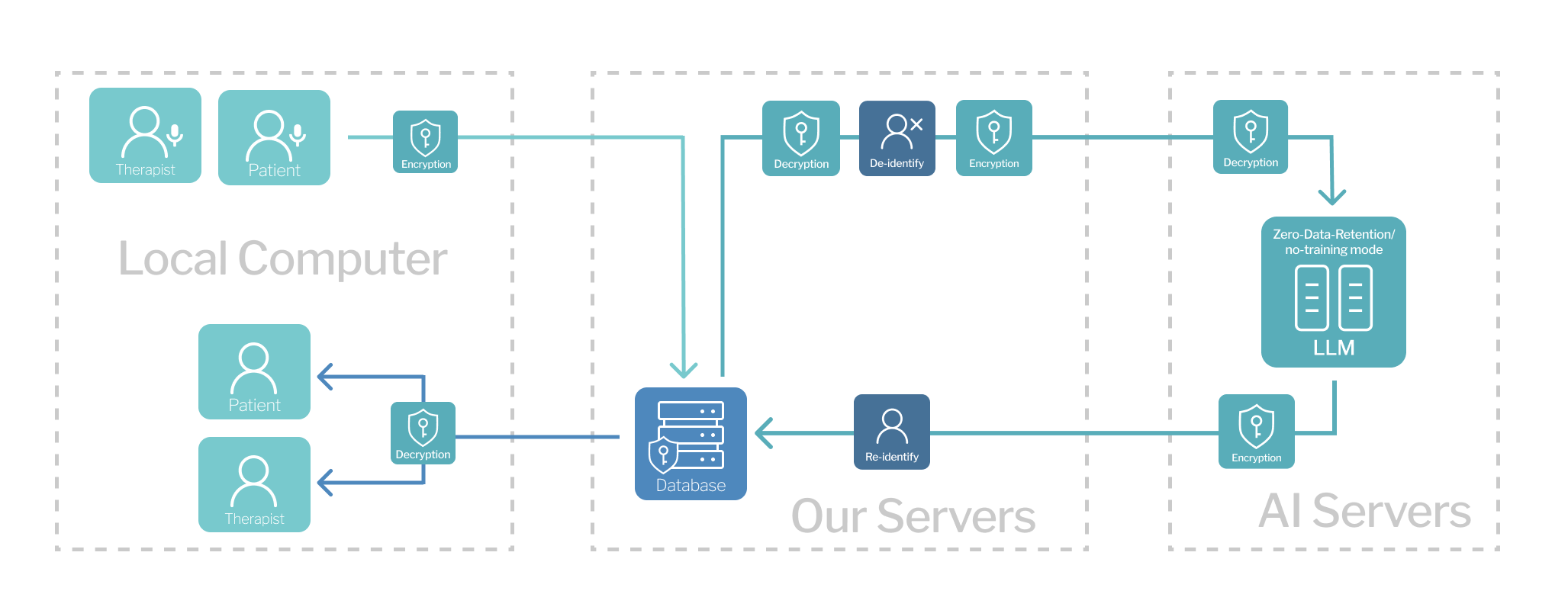
Example of how sessions move through encryption, de-identification, and analysis before results return to clinicians.
What we provide
You bring the study design and hypotheses. We provide a working platform and careful data handling. For research exports and study workflows, we’ll propose a clear plan with you (US-only for now).
- Today: a working platform with consent-first session capture and HIPAA-focused controls
- Proposal: research exports (CSV/JSON) designed around your study aims
- Proposal: de-identified datasets designed for research use
- Proposal: a clear field list (“data dictionary”) so analysis is straightforward
Example outputs (proposal)
Measurement files
CSV exports, scoring definitions, and a clear codebook so cohorts stay consistent over time.
Figures for papers
Longitudinal plots, component profiles, and excerpt-backed summaries that translate into methods sections.
Clinical artifacts
Clinician-facing views and client-ready psychoeducation that can be studied as interventions.
Looking for validation and partnership
ALI is at the measurement and validation stage. Our goal is to build and test language-based measures of alexithymia with you.
Our Validation Goals
- Convergent validity with existing alexithymia and emotion measures.
- Reliability across sessions, contexts, and populations.
- Links to interpersonal distress, attachment patterns, and developmental factors like early language delays.
How You Can Help
- Embed ALI as an additional measurement channel in existing studies or programs.
- Co-design new protocols focused on alexithymia-related language and change over time.
- Help shape thresholds, reporting formats, and clinical wording.
Any diagnostic or regulatory path would be a separate, later stage with its own governance. Today, the focus is on careful measurement, validation, and fit with real clinical work.

Privacy, confidentiality, and HIPAA, clearly explained
US-only for now. Below is the high-level overview; the longer guide goes deeper.
BAAs with core vendors
We have BAAs in place with the vendors we use to run Feelpath (including Zoom, AWS, Kinde, and OpenAI).
Consent at session start
Participants choose what to save and what to share at the start of a session (based on the options in the join flow).
Audit logging
We maintain HIPAA-compliant audit logging to support accountability and review.
Want the full details for your IRB packet and methods section? We publish a longer guide and a PDF you can share with your team.
In case you missed anything
A few of the questions research partners and clinicians most often ask about ALI. For more detail on privacy, data handling, and product usage, you can visit our full FAQ.
No. ALI is designed for research and clinical insight about alexithymia-related patterns in session language. It is not intended to diagnose at this stage and does not replace clinical judgment or therapy.
We are seeking PIs, labs, and individual clinicians who want to study alexithymia-related patterns in language, compare ALI-style indices with existing measures, and help shape how results are visualized and used in practice.
ALI is designed to sit alongside your existing therapy, research, and documentation workflows. With consent, session language is analyzed to produce indices, visuals, and psychoeducation prompts that you can review between or during sessions.
We are building a simple way to derive psychometric-style measures directly from therapy and research sessions, and to pair those measures with personalized psychoeducation for clients who struggle with alexithymia-related traits.
Academic labs and individual clinicians or therapists who are interested in digital language-based measures, alexithymia and affective science, or psychotherapy process and outcome research.
One example is a study where ALI features are turned on for one group and off for another, with outcomes compared every 6–8 weeks. Another is a protocol where participants complete a series of ALI-enabled sessions plus established measures such as PAQ or TAS at baseline and follow-up, so we can examine how ALI composites relate to and predict change on existing scales.
In a research collaboration we aim to provide clearly documented composite and component-aligned scores, links back to the labeled excerpts that support those scores, and a data dictionary or codebook. For appropriate studies we also discuss options for providing de-identified text features or transcripts under a data use agreement.
Feelpath is currently self-funded. We are open to discussing financial support, in-kind engineering and analytics work, or other resources for well-scoped collaborative studies.
ALI follows the same HIPAA-aligned privacy and security practices as the rest of Feelpath: clear consent language about how session language is saved and analyzed, encryption in transit and at rest, access controls, and options for de-identified exports in research settings.
Interested in validating ALI and related measures?
If you’re working in digital mental health, affective science, or psychotherapy process and outcome research, we’d love to compare notes and co-design a study that fits your lab.
Help shape the next measures of alexithymia (ALI)
We are looking for thoughtful partners who care about alexithymia, language, and careful measurement. If this sparks ideas, we would love to talk.