
Help us turn therapy sessions into more continuous care.
We are seeking funding to run staged feasibility and validation studies of our alexithymia-focused workflow in everyday therapy settings.
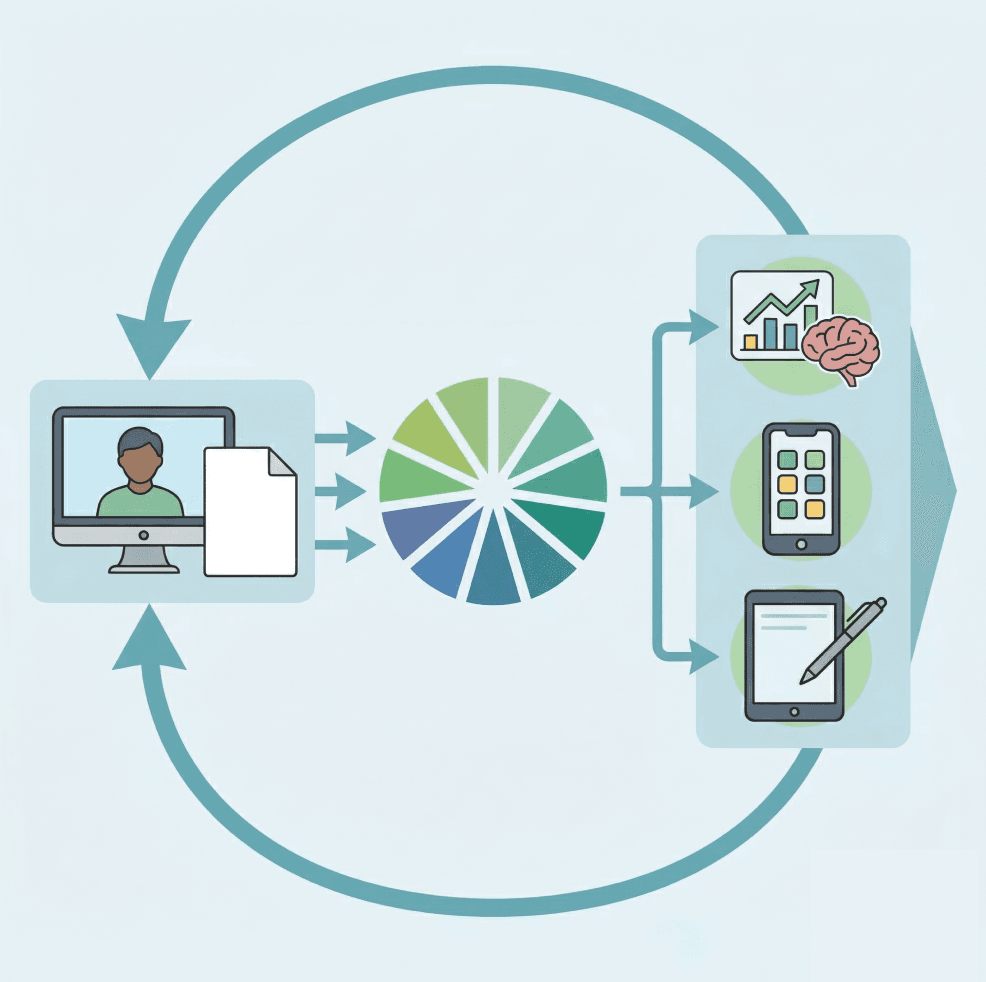
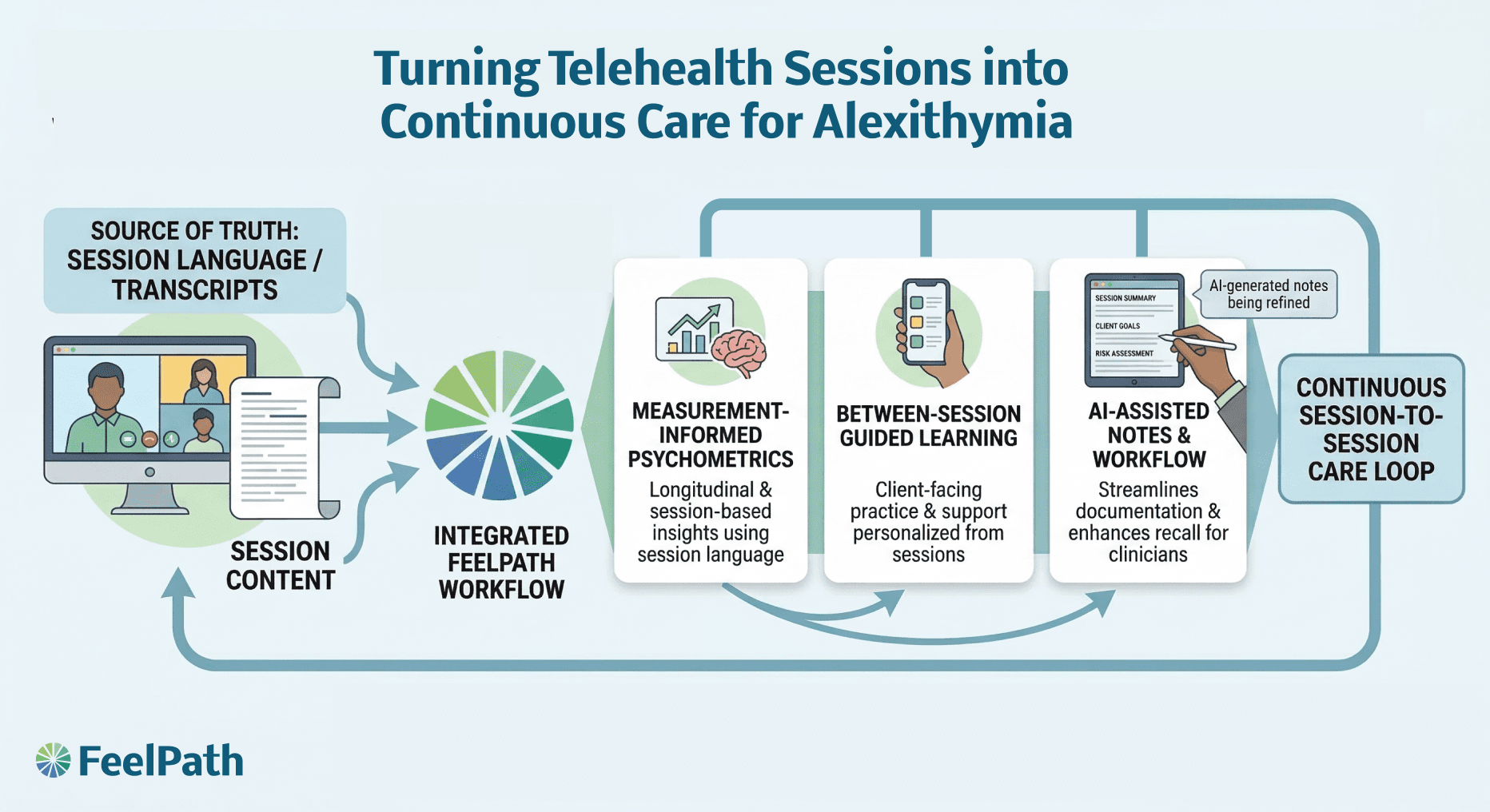
Feelpath's continuous care model is a longitudinal workflow that preserves emotionally meaningful material from each session and carries it into between-session reflection and next-session follow-up through session-derived measurement, guided client learning, and AI-assisted notes for clinicians.
Page overview
What Feelpath is building, why it is needed, and what we want to study
Feelpath is a clinician- and client-centered digital mental health platform designed to improve how alexithymia is identified, tracked, and addressed within routine therapy settings.
In therapy, emotionally meaningful information is often difficult to capture and build on over time. This is especially true for people with alexithymia, where challenges with emotional awareness can limit in-session work, between-session learning, and overall psychotherapy progress.
Feelpath addresses these gaps through longitudinal tracking, in-session reflection tools, structured between-session practice, and clinician-facing tools that support client learning.
We are seeking funding and research partnerships to evaluate the feasibility, validity, and clinical utility of this approach in real-world therapy settings.
A note from the founder

For four years, I've been facilitating peer-based mental health support groups, and I've seen firsthand how emotional clarity and healthy emotional expression have changed my life and the lives of my group members.
I grew up without much emotional language in my home, and it was a confusing journey to build up my awareness and vocabulary. I've felt the impact emotional intelligence can have on my life, in my relationships, and in the lives of my peers: more engagement, more agency, more encouragement week to week, and more ability to see how our growth and efforts have an impact.
I've also talked to hundreds of therapists who have confirmed the importance of this work, and the benefit that clearer visualization could bring to their practice: seeing emotion wheels in session, reviewing emotion-labeled session summaries afterward, annotating transcript excerpts, and observing patterns over time. Now I'm focused on the difficult task of validation and translation: testing these tools against baseline and follow-up measures, and turning what we learn into workflow that clinicians can use in everyday therapy.
Nick Venturino, Founder
The gap we are starting from
In routine psychotherapy, clinically meaningful emotional information often emerges during sessions but is difficult to capture and build on over time. This is especially true for individuals with alexithymia, where difficulties identifying and describing emotions limit what can be accessed and used in treatment.[1]
As a result, therapy often relies on recall, intermittent self-report, and clinician notes, rather than in-the-moment, usable data about emotional experience. This creates gaps in continuity of care, limits the precision of interventions, and makes it difficult to track meaningful change over time.[2]
There is currently little infrastructure to support the ongoing use of in-session emotional data to guide treatment, reinforce learning between sessions, or generate clinically meaningful content that can inform both treatment and research.[3]
What Feelpath is, and what we are testing
Feelpath is designed to get more value out of existing therapy treatment for alexithymia by turning session language into progress markers, between-session guided client learning, and AI-assisted notes for clinicians.
We are building Feelpath as a connected platform for longitudinal, session-based progress signals, personalized between-session support, clinician workflow tools, and research-ready infrastructure.
Feelpath is built around three connected layers:
- Transcript-derived measurement: whether conversation-based markers can capture patterns that are interpretable, clinically meaningful, and worth validating against existing empirically validated measures of alexithymia.
- Client-facing adjunctive aid: whether tools like emotion wheels, emotion annotation, and session-based review actually help clients reflect, label emotions more clearly, and carry the work forward between sessions.
- Therapist workflow: whether these tools can fit into ordinary therapy practice in a way that supports follow-up, recall, and continuity without creating too much friction.
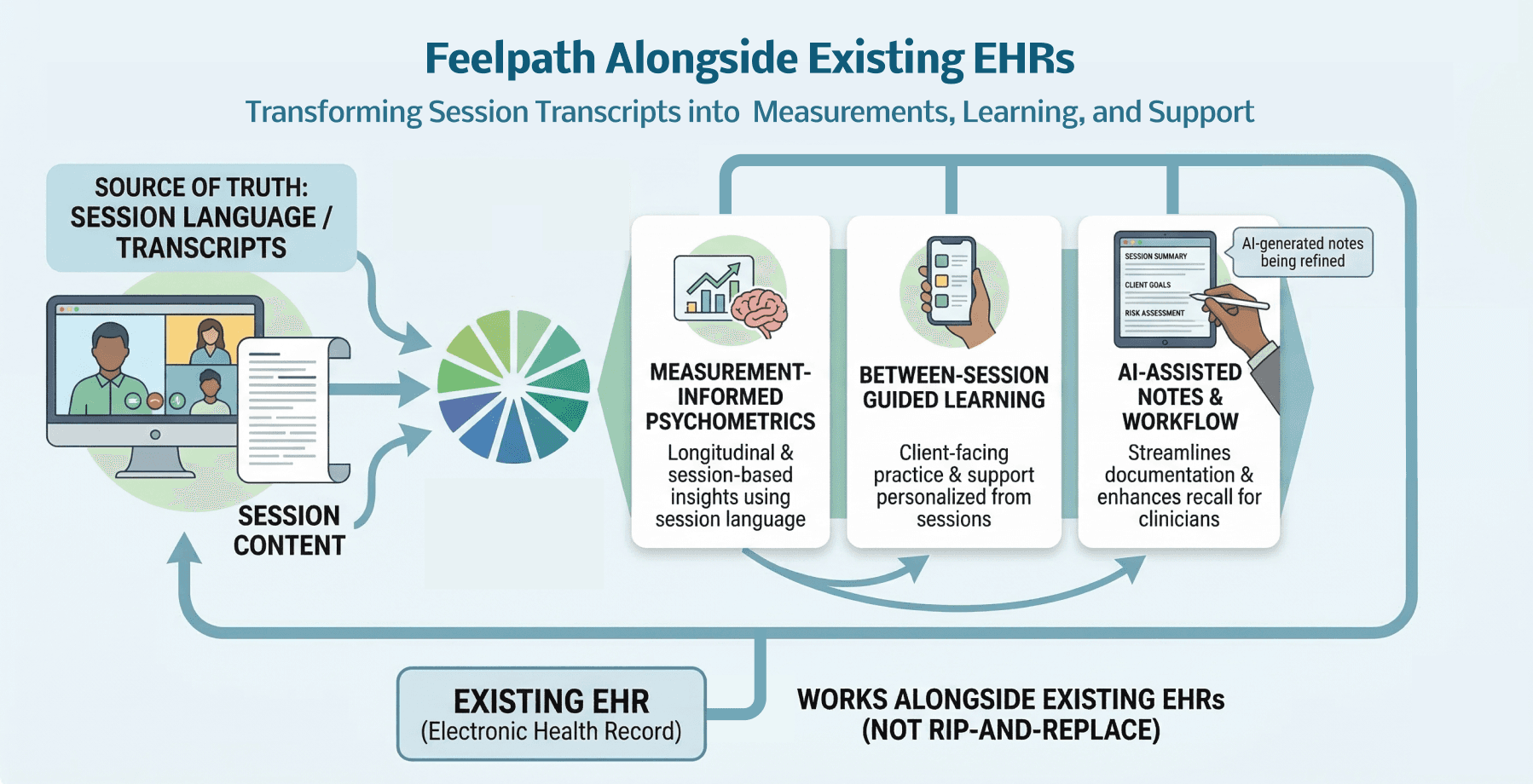
Our next phase is to evaluate Feelpath's clinical and practical value: whether the measurement approach is valid and meaningful, whether the client tools support emotional learning, and whether the platform can be integrated into routine therapy workflows. We aim to make the transition from a working integrated platform to an empirically evaluated approach.
Why this matters for clinical practice and research
We see that Feelpath has a scientific opportunity to test whether routine therapy conversations can become a more useful source of longitudinal guidance in mental health care.
In everyday practice, this matters because therapists are often trying to carry an evolving picture of a client's emotional capacity across many sessions. For therapists, the question is not whether meaningful information shows up in session. It does. The harder question is whether that information can be carried forward clearly enough to help track progress, notice what is still stuck, and decide what to do next.
Therapists want to provide the best possible informed and adaptive care, but they are also realistically trying to avoid adding more documentation burden. That tension often leaves them facing a few recurring challenges:
- hard to manually carry a longitudinal picture across clients and sessions
- hard to confirm whether alexithymia symptoms are truly improving
- hard to recognize early signs of setbacks
- hard to see how and where growth might be stalled
- hard to clarify markers of progress to clients
If this kind of support can be studied and validated well, it could help clinicians follow change more clearly, decide the next focus under this type of emotional uncertainty, adjust treatment with more confidence, and generate stronger practice-based evidence about what helps different clients over time.
Our Research Questions
Measurement
Can we use session conversations to help us understand progress beyond self-report alone?
Between-session support
Can using each client’s own session language make between-session support more personalized?
Implementation / routine care
Can this actually work in routine therapy practice without adding clinician burden?
Learning
Can Feelpath help the mental health field learn more about what works for whom, in what contexts, and why?
If we can answer these questions well, the payoff is a more practice-ready way to see meaningful change, better tailored follow-up, and stronger real-world evidence for mental health research.
What we’ve already done
Here is a visual overview of our progression timeline. It shows what is already in place, what has already been piloted, and what is coming next.
Our Milestones
Developed the core platform
We built the core platform and put HIPAA compliance, privacy, security, transcript capture, consent, redaction, safety features, video UI, the telehealth room, announcements, and login in place.
Launched client + therapist tools
Designed and launched tools for review, reflection, and follow-through.
Already piloted across 300+ peer group sessions
Parts of the platform have already been piloted in real peer-group conversations.
Early study
We are now running the early learning study to see how the product fits real therapy practice, how people use it, and what seems helpful in practice.
Study links
Validation
Next is a more formal validation phase: testing the digital psychometrics, the client tools, and how these fit into therapist workflow.
Study links
Readiness
Then comes broader readiness across more partners and practices, with the training, support, and study setup needed for wider adoption.
We have already built a real product platform around therapy sessions: session and transcript infrastructure, transcript-derived analysis, client-facing emotional learning tools, therapist-facing review tools, and the first layer of research development. What exists today is not just session capture, but a set of connected tools for seeing more from the session, carrying the work forward between sessions, and making that work more visible to both clinicians and clients.
Parts of Feelpath have already been piloted across more than 300 peer group sessions, giving us an early glimpse at how these tools support reflection, expression, and follow-through in real conversations over time. On the client side, that already includes tools like emotion wheels, emotion annotation, and session-based review.
On the therapist side, it already includes emotional review, emotion annotation, emotion analytics, and other session insights. The next phase is to study this rigorously in everyday therapy settings, support real use in practice, and move from a working integrated platform to a feasibility-tested and empirically validated approach.
What needs to happen next
Rather than a large formal validation trial, our immediate next step is a feasibility study in routine therapy settings. We already have substantial interest. This phase now requires funded execution across recruitment, participant compensation, therapist co-design time and support, and research operations so we can generate the feedback and data needed to improve Feelpath.
This feasibility phase is designed to test implementation fit and data quality in everyday therapy settings, while generating early signal data to shape later formal validation studies. The overall aim of this feasibility study is to gather therapist and client feedback on usefulness, helpfulness, and workflow fit by running real sessions on the platform.
Specifically, the study will focus on:
- run real therapy sessions on the platform with compensated participants
- co-design how Feelpath notes, summaries, and progress information fit into therapists' existing documentation workflows
- collect therapist and client feedback on usefulness and workflow fit
- gather usage and engagement data from real sessions and between-session use
- collect baseline and follow-up signals, benchmarked against existing validated alexithymia measures
- findings from this phase will be used to refine Feelpath and inform subsequent validation studies (e.g., psychometric + workflow + utility).
Feelpath Research
Our Study Plans
Our aim is to start with practical questions about usefulness, workflow, and trust and learn from real session data responsibly.
Feelpath Funding
We are seeking staged support across Early Proof, Validation, and Readiness to move from real-world feasibility to rigorous validation and broader implementation.
| Goals | Typical range | Steps |
|---|---|---|
Early proof | $300k-$600k | The steps of this stage are to run the early learning study in real-world therapy settings and learn whether Feelpath is usable, helpful, and worth deeper study. |
Validation | $1.0M-$2.0M | Turn early proof into a more formal validation phase for the transcript-derived measures, client tools, and therapist workflow. |
Readiness | $3.0M-$7.0M | Move from early evidence to readiness across more partners and practices, with the support and study setup needed for wider use. |
Funding paths in detail
Early proof ($300k-$600k)
Early proof ($300k-$600k)
The steps of this stage are to run the early learning study in real-world therapy settings and learn whether Feelpath is usable, helpful, and worth deeper study.
- recruit and support a small number of therapist collaborators
- run the early learning study in routine therapy settings
- interview therapists and clients about workflow, trust, and usefulness
- collect workflow, usability, engagement, and feedback data
- define and pilot therapist workflow handoff into existing EHR workflows (including SimplePractice)
- collect baseline and follow-up signals in emotion labeling, benchmarked against existing validated alexithymia measures
- document what seems helpful, for whom, and under what conditions
- develop product further, specifically to deliver the study and capture the right data
The spending at this stage will go towards:
- therapist co-design time and support
- participant recruitment, screening, and compensation
- therapist and client interview time
- IRB / ethics review
- study coordination and scheduling
- product development needed to run the study smoothly
- methods support for early analysis
Validation ($1.0M-$2.0M)
Validation ($1.0M-$2.0M)
Turn early proof into a more formal validation phase for the transcript-derived measures, client tools, and therapist workflow.
- prepare and launch a more formal validation study
- test whether transcript-derived measures align with meaningful alexithymia-related change, external benchmarks, and human judgment
- review and code session excerpts
- validate the client-facing tools and whether they support emotional learning
- validate the fit of therapist workflow more rigorously
- evaluate and test scalable integration pathways, including standards-based exchange where feasible
- improve study methods and analysis
The spending at this stage will go towards:
- therapist onboarding and site support for the validation study
- participant recruitment, compensation, and follow-up
- human coding and review of session excerpts
- protocol development, statistics, and analysis
- product and data-capture work needed for the validation study
Readiness ($3.0M-$7.0M)
Readiness ($3.0M-$7.0M)
Move from early evidence to readiness across more partners and practices, with the support and study setup needed for wider use.
- support more partner practices and study sites
- build training, onboarding, and support for wider use
- learn what implementation requires in real practice
- complete broader validation work across more partners
- prepare for larger studies and broader rollout into practice
The spending at this stage will go towards:
- partner onboarding and implementation support across more practices
- training materials and technical support
- implementation interviews and workflow review
- study operations across more sites
- product work needed for broader use
- analysis, reporting, and rollout materials
Selected References:
- [1] Frontiers in Psychiatry (2020). The Impact of Alexithymia on Treatment Response in Psychiatric Disorders: A Systematic Review. Link.
- [2] Frontiers in Psychiatry (2017). Moderating Effects of Alexithymia on Associations between the Therapeutic Alliance and the Outcome of Brief Psychodynamic-Interpersonal Psychotherapy for Multisomatoform Disorder. Link.
- [3] Journal of Psychosomatic Research (2020). Twenty-five years with the 20-item Toronto Alexithymia Scale. Link.
- [4] European Psychiatry (2019). Investigating alexithymia in autism: a systematic review and meta-analysis. Link.
- [5] Pain (2019). Alexithymia in individuals with chronic pain: a systematic review and meta-analysis. Link.
- [6] Psychiatry Research (2015). The association between alexithymia as assessed by the 20-item Toronto Alexithymia Scale and depression: a meta-analysis. Link.
If this work resonates
We'd be glad to talk. We are looking for support that helps us run the right studies, validate the platform carefully, and build from what we learn.
We would especially welcome conversation around research funding, philanthropic support, pilot partnerships, clinical research collaborators, and introductions to program officers, funders, or academic partners.