
Note from the founder
When I first took the PAQ-24, one thing really jumped out at me: my DIF (difficulty identifying feelings) was high, while my DDF (difficulty describing feelings) was much lower. That surprised me and I didn't know what it meant.
What I learned is that measured alexithymia is actually a few different traits grouped together. You can think of it as:
- Recognition: "I feel something, but I can't tell which emotion it is."
- Expression: "I know what I'm feeling, but I can't say the words."
- External orientation: "I can tell you what happened, but not what I felt."
I also learned the underlying drivers can be quite different. For example, DIF can come from weak interoception, emotional numbing, or delayed awareness / delayed emotional processing. Whereas DDF can come from social stress or social stigma from talking about feelings, among other things. There is overlap between the two, and hopefully this page helps clarify this more.
How the PAQ measures this
The Perth Alexithymia Questionnaire (PAQ-24) frames alexithymia as a multidimensional construct with components.
- N-DIF: Trouble identifying negative emotions.
- P-DIF: Trouble identifying positive emotions.
- N-DDF: Trouble describing negative emotions.
- P-DDF: Trouble describing positive emotions.
This matters because many clients are not alexithymic in the same way. A person can score high on DIF and lower on DDF, or the reverse, and that subscale/composite score pattern often changes treatment planning.
PAQ scores show where the breakdown clusters. Brain findings help explain why those patterns can look different in session.
What we know about brain differences
Brain research on alexithymia supports a useful clinical split: some difficulties are more about detecting and organizing internal emotional signals, while others are more about translating those signals into words under pressure. In practice, this helps explain why two clients might both seem "stuck" but actually will need different first treatment steps.
Strongest practical takeaway is pattern-level:
DIF ~ signal identification
DDF ~ signal-to-language expression.
If signal identification is the main issue, start with interoceptive and differentiation work. If signal-to-language expression is the main issue, start with vocabulary, prompts, and low-pressure expression practice. We'll explain this more in the next sections, and how Feelpath helps with both.
Next, map this into session-level patterns: where the sequence breaks, what that looks like in the room, and which first intervention step reduces friction.
Alexithymia: Barriers to Emotional Processing
Emotional processing usually follows a simple sequence:Body signal -> emotion meaning -> emotion words
Alexithymia shows up when that sequence breaks. But why does it breakdown?
The graphic below maps some of the breakdown points and barriers to emotional processing: difficulties identifying feelings on the left, difficulty describing feelings on the right, and shared contributors in the center.
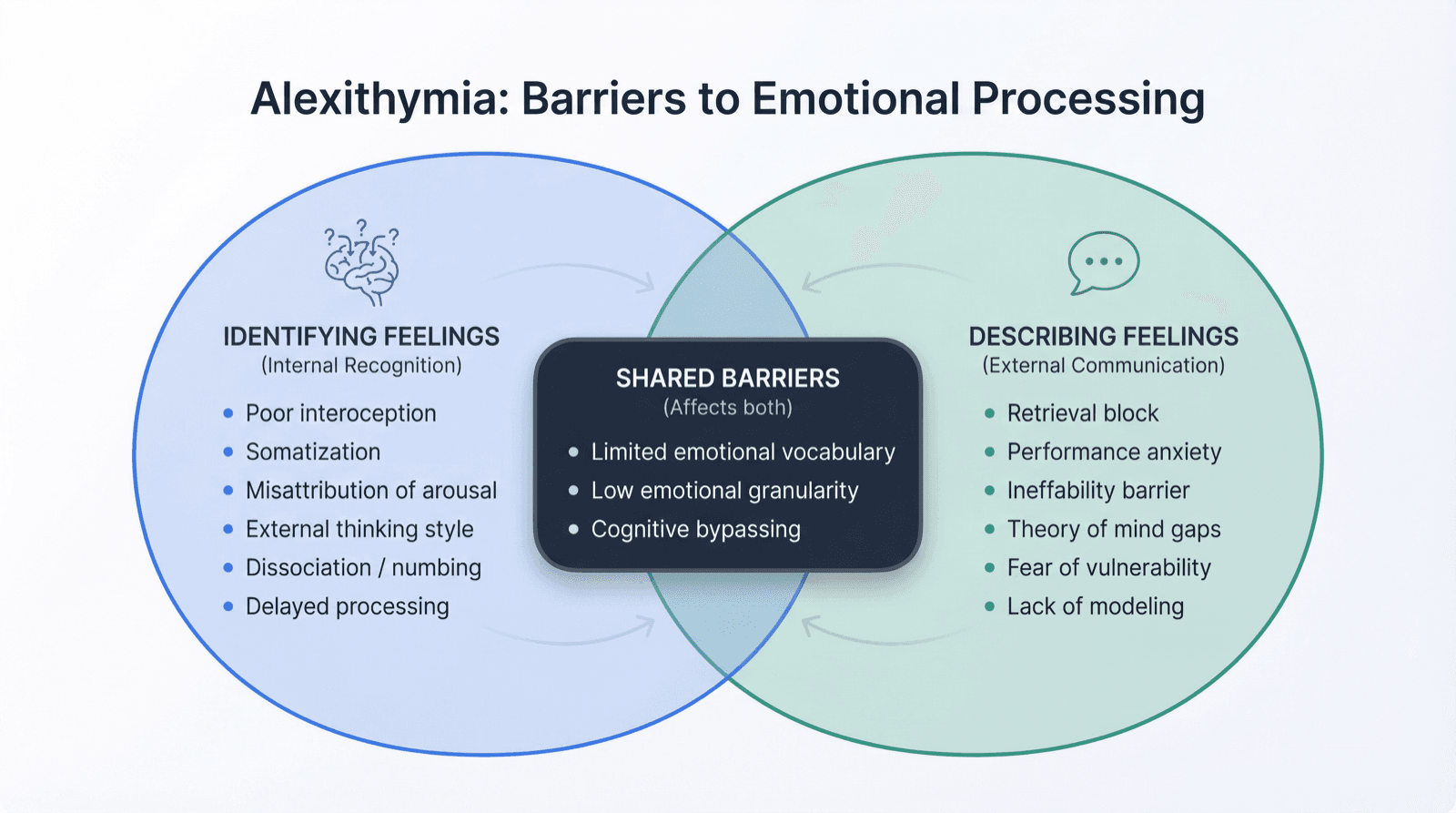
Difficulty identifying feelings
Internal recognition
This pattern usually means emotional activation is present, but the person cannot reliably sort that signal into a clear feeling yet.
Primary barriers
- Poor interoception: Inability to feel internal bodily signals.
- Somatization: Interpreting emotions strictly as physical illness.
- Misattribution of arousal: Confusing anxiety with hunger, fatigue, or caffeine.
- External thinking style: Defaulting to facts/solutions over internal experience.
- Dissociation / numbing: Going blank, shutting down, or feeling “nothing.”
- Delayed processing: Feelings register later, after the moment has passed.
Difficulty describing feelings
External communication
This pattern usually means the person knows what they feel, but has trouble finding clear words "quickly enough" to share it with someone else. We write "quickly enough" to mean this is a timing issues, which we explain more in our neuroscience section.
Primary barriers
- Retrieval block: “Tip of the tongue” phenomenon under stress.
- Performance anxiety: Fear that words will fail to capture the reality.
- Ineffability barrier: Belief that the feeling is too abstract for speech.
- Theory of mind gaps: Assuming others already know how you feel.
- Fear of vulnerability: Holding back language that would expose needs or feelings.
- Lack of modeling: Not having examples for how to name feelings with clear everyday words.
How These Barriers Map to the Brain
The barriers above can be understood through one practical sequence:Detect -> Differentiate -> DescribeIn most clients, DIF shows up earlier in that sequence (detecting and sorting internal signals), while DDF shows up later (turning a felt state into clear language under pressure).
The first breakpoint usually appears in Detect/Differentiate: clients can feel activation but struggle to sort it into a precise label, especially when arousal, somatization, numbing, or delayed access is in the mix.
The second breakpoint usually appears in Describe: clients may recognize the state internally but lose retrieval and verbal precision under pressure, so speech becomes vague, slowed, factual, or shut down.
These are overlapping, pattern-level tendencies, not rigid signatures for a single person. The strongest clinical use is sequencing: support signal identification first when DIF is primary, and support signal-to-language expression first when DDF is primary. This also explains why progress should be tracked in two milestones: "I can name it internally" and "I can communicate it clearly."
Start with salience and interoception
Salience is your brain's "this matters right now" detector. It tags signals as important (inside your body or outside in the environment) and shifts attention/resources toward them.
Interoception is sensing internal signals (heartbeat, tension, gut feeling). Salience is deciding which of those signals should guide action right now. When this signal-reading layer is inconsistent, clients may feel activation but still struggle to identify what emotion is present.
Neuroscience Terminology Deep Dive
- Insula: The brain's internal body-signal dashboard.
- ACC (anterior cingulate): A control hub for attention, conflict, and effort.
- Salience network: System that flags "this matters right now."
- Amygdala: Emotional relevance and alarm signal.
- Sensorimotor regions (SMA/pre/postcentral): Action/body-mapping support.
IFG/STG refers to two brain regions often discussed together in language and social-emotional processing:
- IFG = Inferior Frontal Gyrus. Commonly associated with speech production, language formulation, and top-down control during verbal expression.
- STG = Superior Temporal Gyrus. Commonly associated with speech perception, auditory language processing, and prosody (tone/emotional contours of speech).
For this page, use this shorthand:
- IFG helps with putting thoughts/feelings into words.
- STG helps with hearing/decoding speech and emotional tone.
Findings translated for clinical practice
DIF often tracks with body-signal systems (especially insula/salience areas).
Clinical implication: when someone says "I don't know what I feel," that can be a real sensing problem, not just resistance.
DDF often tracks with expression/labeling systems, especially under emotional pressure.
Clinical implication: some people feel it internally but go blank when asked to say it out loud.
DDF can involve slower emotional labeling in some tasks, even when accuracy is preserved.
Clinical implication: pace matters. If you rush expression, you may underestimate what the client can articulate with structure and time.
Both DIF and DDF can involve weaker coordination between feeling and organizing hubs.
Clinical implication: use a two-step loop: first help notice internal state, then help translate it into shareable language.
Language-route evidence and prosody findings show communication systems are part of the picture.
Clinical implication: alexithymia is not only about "feeling." Language access and emotional decoding both shape alliance moments.
Affect-labeling work shows that putting feelings into words can recruit control systems and lower alarm reactivity.
Clinical implication: naming feelings is not only insight; it can directly support regulation.
Meta-level interoception findings are usually strongest for DIF/DDF (vs EOT).
Clinical implication: DIF and DDF are often the most actionable facets when your goal is emotional awareness and communication.
How PAQ scores map to intervention selection
This table has one job: pick the best first treatment target. Difficulty identifying feelings and difficulty describing feelings are distinct patterns, and starting with the primary pattern usually creates faster traction.
| Score focus | First target | Prioritize first |
|---|---|---|
| More Difficulty Identifying Feelings | Emotion detection and discrimination. | Interoceptive check-ins, body-to-feeling mapping, and constrained label choices. |
| More Difficulty Describing Feelings | Emotion-to-language translation. | Sentence stems, word-retrieval scaffolds, and brief communication rehearsal. |
Reassess subscale and composite scores every 4 to 8 weeks and shift emphasis as scores change.
A practical read in session: "I can't answer that" can reflect capacity limits under pressure, not resistance.
Use two milestones when you track progress: first "I can now name what I feel," then "I can now say it to another person."
Which emotional skills help your DIF and DDF clients?
Emotional skills do not affect all difficulties in the same way.
DIF support focus
Skills that tend to improve DIF
- Body signal tracking.
- Emotion differentiation practice.
- Slowing down attention to inner cues.
- Mapping sensations to likely emotion families.
DDF support focus
Skills that tend to improve DDF
- Emotion word expansion.
- Sentence stem practice.
- Short descriptive scripts.
- Graded sharing in a safe relational context.
Many clients need both tracks, but starting with the main pattern usually reduces overwhelm and supports alliance.
Clinical implications for therapy and care
- Do not treat alexithymia as one thing. DIF-heavy and DDF-heavy clients can look similar but need different help first.
- Match intervention to the main difficulty. DIF-heavy work usually emphasizes body tracking, interoceptive awareness, and emotion differentiation. DDF-heavy work usually emphasizes emotion vocabulary, sentence stems, and low-pressure expression practice.
- Interpret behavior more accurately. "I can't answer that" may reflect capacity limits in the moment, not resistance.
- Track progress differently. "I can now name what I feel" and "I can now say it to another person" are different milestones.
Once the main pattern is clear, intervention sequencing gets simpler and more precise.
What Feelpath tracks over time
Track change in small steps:
- Faster recognition of emotion shifts.
- Fewer "I feel nothing" moments during activation.
- More specific feeling words.
- Better transfer from session to real-life conversations.
- Less symptom substitution into purely somatic complaints.
Progress is usually uneven and still meaningful.
Further reading
For related clinician resources, see A Clinician's Guide to Noticing Alexithymia, Psychometrics and Session Insights, and Is Alexithymia a Disorder?.