

Alexithymia is a trait characterized by difficulty identifying, understanding, describing, and distinguishing one's own emotional states. Although it is often discussed in relation to autism, alexithymia is not itself a diagnosis of autism or any other specific condition. Instead, it is a dimension of emotional processing that can occur in neurotypical and neurodivergent people alike.
The relationship between alexithymia and neurodivergence is particularly interesting because many neurodivergent presentations involve differences in attention, sensory processing, interoception, executive functioning, communication, and emotional regulation. These differences can sometimes make it more difficult to recognize and interpret internal emotional states.
At the same time, not every neurodivergent person experiences alexithymia, and not every person with alexithymia is neurodivergent. Understanding this distinction is important because it prevents stigma, overgeneralization, and stereotyping.
Neurodivergence and Emotional Processing
Neurodivergence is an umbrella concept describing variations in neurological functioning that differ from what is considered “typical.” It can encompass conditions and experiences including Autism, ADHD, Dyslexia, Tourette Syndrome, and other forms of neurological or neurodevelopmental difference. These conditions present uniquely and diversely. There is no single “neurodivergent way” of experiencing emotions. However, many neurodivergent people describe differences in how they notice, process, regulate, communicate, or respond to emotional experiences.
These differences can arise from several overlapping mechanisms, including:
- Interoceptive differences
- Sensory sensitivity or sensory seeking
- Executive-function differences
- Differences in attention
- Difficulty shifting attention
- Emotional regulation difficulties
- Differences in language processing
- Social-communication differences
- Overstimulation
- Masking and compensatory strategies
- Difficulty recognizing internal physiological states
Some of these factors can overlap with the characteristics associated with alexithymia.
Alexithymia and Autism
The relationship between alexithymia and autism is one of the most extensively discussed connections between alexithymia and neurodivergence. Research has found that alexithymia is relatively common among autistic people. However, this does not mean that alexithymia is synonymous with autism. One important distinction is that autism involves differences in social communication, restricted or repetitive behaviors, sensory processing, and patterns of interests or behavior. Alexithymia, by contrast, specifically concerns aspects of emotional awareness and processing.
A person can therefore be:
- Autistic without significant alexithymia
- Autistic with substantial alexithymia
- Non-autistic with alexithymia
This distinction has helped researchers reconsider some characteristics historically attributed to autism. For example, apparent difficulty recognizing another person's emotions may sometimes reflect social-processing differences, alexithymia, or a combination of both. Similarly, a person who appears emotionally detached may actually experience strong emotions but have difficulty identifying or communicating them.
Interoception may be particularly important…
Interoception is the ability to perceive and interpret signals originating inside the body. Emotions are closely connected to bodily states. Anxiety might involve a racing heart or stomach discomfort. Anger might involve muscle tension and increased physiological arousal. Sadness might involve heaviness, fatigue, or changes in breathing. If someone has difficulty interpreting these internal signals, identifying emotions can become more difficult.
This does not mean that all autistic people have impaired interoception. Interoceptive experiences vary considerably among autistic individuals, as well as neurotypical folks. Nevertheless, differences in interoception may provide one understanding as to how autism and alexithymia overlap.
Alexithymia and ADHD
Alexithymia can also occur in people with ADHD. ADHD is primarily associated with differences in attention, impulse control, activity level, and executive functioning, but many people with ADHD also experience significant differences in emotional regulation abilities.
ADHD-related emotional experiences can include:
- Rapid changes in emotional intensity
- Difficulty shifting away from emotionally charged thoughts
- Strong reactions to frustration
- Difficulty pausing before responding
- Emotional impulsivity
- Difficulty regulating attention toward or away from emotional information
- Becoming overwhelmed by competing internal and external stimuli
These experiences can interact with alexithymia. For example, someone might experience a sudden and intense emotional reaction but have difficulty determining exactly what emotion triggered it. They may know that they are extremely upset but struggle to explain whether the underlying feeling is anger, rejection, anxiety, disappointment, shame, or some combination.
Executive dysfunction can further complicate this process. Identifying an emotion requires attention to internal information. Naming it requires accessing language. Understanding its cause may require working memory and reflection. Deciding what to do with the emotion requires planning and inhibition. When these processes are already difficult, emotional self-awareness can become more complicated.
Sensory Overload and Emotional Confusion
Sensory processing differences can also contribute to experiences that resemble alexithymia. A neurodivergent person may become overwhelmed by noise, light, touch, crowds, smells, tastes, movement, or other competing sensory information.
When the nervous system becomes overloaded, the person may experience:
- Irritability
- Anxiety
- Withdrawal
- Shutdown
- Agitation
- Fatigue
- Dissociation
- Difficulty communicating
- Emotional numbness
During intense sensory overload, identifying one’s precise emotional state may become extremely difficult. Someone may simply know that they cannot tolerate anything else. Consequently, what appears to be emotional confusion may sometimes involve an interaction between sensory overload, physiological arousal, interoception, and emotional processing.
Masking and the Development of Emotional Disconnection
Masking, in the context of neurodivergence, is a conscious or unconscious strategy where someone hides or changes their natural behaviors in order to appear neurotypical. People often do this to fit in, avoid bullying, and handle overwhelming social or work settings. It functions to adapt one’s behavior to social expectations, but it causes deep exhaustion.
A person who repeatedly learns to suppress their natural reactions or behaviors may become accustomed to asking:
"What emotion am I supposed to show here?"
rather than:
"What am I actually feeling?"
Over time, this can make internal emotional signals more difficult to recognize. For example, someone might learn that showing frustration is socially unacceptable, so they automatically suppress signs of anger. They may become extremely skilled at appearing calm while remaining unaware of the emotional tension accumulating internally.
Eventually, the person may experience their emotion primarily through indirect signals:
"I suddenly became exhausted."
"My stomach hurts."
"I can't concentrate."
"I need to be alone."
"I don't know why I'm so irritated."
"I feel completely numb."
This does not necessarily mean that masking causes alexithymia. Rather, masking can potentially interact with pre-existing differences in emotional awareness and make internal emotional states more difficult to access.
Shutdown, Meltdown, and Emotional Awareness
Neurodivergent people may sometimes experience shutdowns or meltdowns when emotional, sensory, cognitive, or social demands exceed their available capacity. These experiences can complicate emotional awareness.
During overwhelming states, the brain may prioritize immediate regulation and survival over reflective self-analysis. Asking someone in the middle of severe overload, "How are you feeling?" may therefore produce little useful information. They may genuinely be unable to answer.
After the episode, emotional awareness may gradually return. Some people can then identify the contributing factors retrospectively, while others may still have difficulty reconstructing what happened.
This illustrates an important principle:
The ability to identify an emotion can change depending on one's level of neurological and physiological arousal.
Alexithymia should therefore not necessarily be understood as a constant inability to experience or understand emotions.
Emotional Intensity and Alexithymia Can Coexist
One of the most common misconceptions about alexithymia is that it means someone does not feel emotions strongly. In reality, difficulty identifying emotions and emotional intensity can coexist. A person might experience emotions extremely powerfully while having very little vocabulary for those experiences.
This can produce a confusing combination:
"I feel something enormous, but I don't know what it is."
This distinction is especially important when discussing neurodivergent people, because emotional dysregulation and alexithymia can occur simultaneously. Someone may therefore experience intense emotional reactions while simultaneously having difficulty understanding what caused them. The result can be emotional experiences that feel sudden, mysterious, or disproportionate because the person has not been consciously tracking the buildup.
Why Emotional Vocabulary Matters
Language provides one method for organizing internal experiences. Someone who has internalized a rich emotional vocabulary may distinguish among feelings like:
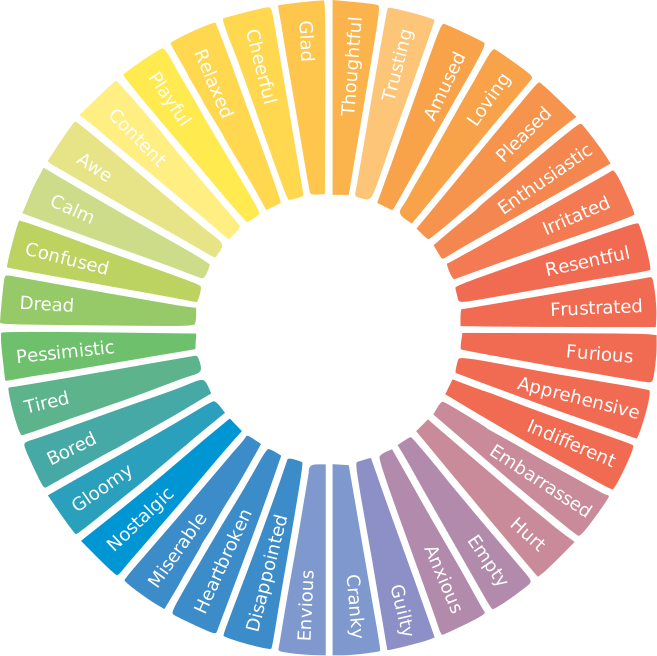
Someone experiencing alexithymia may instead group many of these experiences together as simply "bad” or “good.” This does not mean the underlying emotional experience is necessarily less complex. It means the person may have fewer accessible conceptual categories for interpreting it.
Building emotional vocabulary can therefore be useful, although simply teaching someone more emotion words does not necessarily eliminate alexithymia. Emotional awareness also depends on attention to internal states, interoception, memory, context, and the ability to connect bodily sensations with emotional concepts.
Alexithymia Is Not the Same as Emotional Detachment
Another important misconception is that alexithymia necessarily makes someone cold, uncaring, or emotionally detached. A person may have considerable difficulty identifying their own emotions while still caring deeply about other people. Likewise, difficulty expressing emotion does not necessarily indicate lack of emotion.
Someone might struggle to say "I love you," cry when overwhelmed rather than when consciously sad, or become unusually quiet when deeply distressed. From the outside, these behaviors may be interpreted as indifference. Internally, however, the person may be experiencing something very different. This distinction is particularly important in relationships, where differences in emotional communication can easily be mistaken for differences in emotional investment.
The Relationship Between Empathy and Alexithymia
Alexithymia is sometimes incorrectly treated as equivalent to a lack of empathy.The relationship is considerably more complicated. Empathy involves multiple processes, including recognizing another person's emotional state, understanding their perspective, and responding appropriately. A person can have difficulty identifying their own emotions while still caring deeply about another person's feelings.
In some cases, alexithymia may make emotional communication more difficult because the person has trouble using their own emotional experiences as reference points. But difficulty identifying emotions should not automatically be interpreted as an absence of compassion, concern, or moral understanding.
Neurodivergence Can Make Emotional Processing More Nonlinear
For many neurodivergent people, emotional awareness does not necessarily happen in a straightforward sequence.
A simplified model might be:
Event → emotion → recognition → interpretation → response
But someone's actual experience may look more like:
Event → bodily sensation → overwhelm → behavioral reaction → exhaustion → later reflection → eventual identification of emotion
This difference can be significant. A person may only realize that they were angry several hours later. They may understand that they were anxious only after the situation has ended. They may discover that what they interpreted as irritation was actually sensory overload. They may recognize sadness only after becoming unusually tired or withdrawn. This delayed emotional recognition can be particularly confusing because other people may assume that emotional awareness should occur immediately.
Why Misunderstanding Alexithymia Can Be Harmful
When alexithymia is misunderstood, neurodivergent people can be labeled as:
- Uncaring
- Emotionally immature
- Detached
- Overreactive
- Dramatic
- Cold
- Difficult
- Unempathetic
These interpretations may overlook the underlying difficulty.
A person who cannot identify their emotional state may need more time and structure to process an experience rather than criticism for failing to immediately explain it.
Questions such as "What are you feeling?" can sometimes be difficult to answer.
More concrete questions may be easier:
- "Do you feel tense or relaxed?"
- "Do you want to stay here or leave?"
- "Are you feeling overwhelmed?"
- "Did something someone said bother you?"
- "Do you need quiet?"
- "Would you like some time before talking about it?"
These questions provide external structure for a process that may be difficult to perform internally.
Supporting Emotional Awareness
For neurodivergent people experiencing alexithymia, emotional awareness can sometimes be strengthened by approaching emotions indirectly.
Start with the body:
Instead of asking, "What am I feeling?" someone might begin with:
- What is my heart doing?
- Is my breathing different?
- Are my muscles tense?
- Does my stomach feel different?
- Am I hot or cold?
- Do I feel restless?
- Do I want to move, hide, cry, or escape?
These observations can provide clues about the underlying emotional state.
Use concrete descriptions:
Rather than immediately searching for the perfect emotion word, it can be useful to describe what happened:
"My chest feels tight and I want to leave."
From there, a person can consider possible interpretations.
Track patterns:
Journaling, mood tracking, or other forms of self-monitoring can help establish connections between situations, physical sensations, emotions, and behaviors. Over time, patterns may become easier to recognize.
Use emotion wheels or structured lists:
An emotion wheel can provide categories when spontaneous emotional vocabulary is difficult to access. However, these tools work best as aids rather than tests. There is no requirement to identify the "correct" emotion immediately.
Allow delayed processing:
Some people need substantial time before they can understand what they experienced. A delayed realization is still emotional awareness. "Now I understand what I was feeling earlier" is a meaningful form of emotional processing.
The Importance of Avoiding Overgeneralization
It is tempting to create a simple equation: Neurodivergence → alexithymia → emotional processing difficulties.
But the reality is much more complicated. Neurodivergent people differ enormously from one another. Some have exceptionally strong emotional awareness. Some have difficulty identifying emotions. Some experience intense emotions but can name them easily. Others experience relatively subtle emotions but understand them clearly. Alexithymia itself also exists on a spectrum. Rather than asking whether someone "has emotions" or "understands emotions," it is often more useful to ask which part of the emotional process is difficult.
Is the difficulty:
- Detecting bodily signals?
- Identifying the emotion?
- Differentiating similar emotions?
- Finding words?
- Understanding the cause?
- Regulating the emotion?
- Communicating it to another person?
- Knowing what action to take?
Different difficulties can require different forms of support.
Conclusion
Alexithymia and neurodivergence are closely related in some people, but they are not synonymous. Alexithymia can occur across a range of neurodivergent experiences, including autism and ADHD, and may interact with differences in interoception, executive functioning, sensory processing, attention, emotional regulation, communication, and masking. Perhaps the most important distinction is between having an emotion and being able to identify it.
A person may feel deeply while struggling to understand what they feel. They may care intensely while having difficulty communicating that care. They may experience overwhelming emotional states without being able to identify their source until much later. Understanding alexithymia through this lens can lead to a more compassionate interpretation of neurodivergent emotional experiences. Rather than assuming that a person who cannot immediately describe an emotion does not have one, it may be more accurate to recognize that emotional awareness is itself a complex neurological process—and that people differ significantly in how they perceive, interpret, organize, and communicate their inner worlds.
For many neurodivergent people, the goal is therefore not to become "more emotional." The emotions are often already there. The goal is to develop better access to them: to recognize the body's signals, connect those signals with emotional concepts, understand what triggered them, and eventually find language that accurately communicates an experience that may have always been present but difficult to name.
Clinical index